

The international fundraising think tank Rogare has expanded the typology of disintermediation in the nonprofit sector, first published in the Journal of Philanthropy and Marketing (now just Journal of Philanthropy) in 2023.
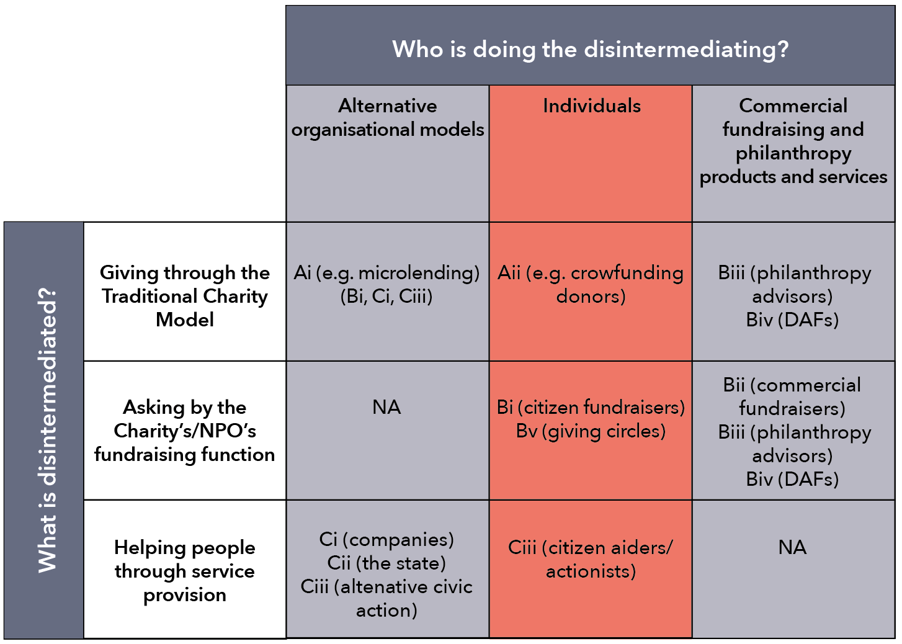
The expanded typology – presented in the new white paper Death by a thousand cuts: How other actors are displacing charities from giving, asking for support, and providing help – is the first phase of a four-phase collaboration with Kingston University in London that will help charities ‘reintermediate’ into the relationships and processes from which they are being displaced.
As well as considerably expanding the subtypes and variants in the typology, the new white paper provides a full consideration of how philanthropy advisors, donor advised funds and giving circles can displace fundraisers and introduces two new ideas: ‘control’ of a relationship as a marker for disintermediation, and the new concept of ‘citizen fundraising’.
Who controls stakeholder relationships?
Who maintains control in relationships with stakeholders has emerged as a key marker for determining whether a nonprofit has been displaced. This is perhaps most relevant for forms of disintermediated fundraising. If charities have access to donors to steward relationships with them and make further asks, then any fundraising done by external actors or suppliers is more likely outsourced.
But if those external actors restrict charities’ access to donors and guard their data, then the fundraising has been disintermediated. Some types of fundraising products – such as personal giving apps and shopping websites – use donor privacy as selling point.
The new white paper includes philanthropy advisors, donor advised funds and giving circles as ways that charities can be cut out of and displaced from relationships with donors. Based on ideas presented in supplementary discussion paper written by Rogare Critical Fundraising Network member Cherian Koshy (vice president of Kindsight), we argue that not only can philanthropy advisors displace charities from asking for support, but they can also take over as the “primary interpreters and stewards of donor intent, inserting themselves as the central locus of decision-making, relationship management, and impact evaluation”.
Professional philanthropic advice thus introduces a new level of intermediation between fundraisers and donors, with advisors acting as gatekeepers to donors.
Regarding DAFs, the white paper argues that they “arguably represent one of the most structurally significant forms of disintermediation in the modern philanthropic ecosystem: DAFs do not simply mediate giving, they restructure it by separating the economic, emotional, and relational components of generosity into different moments and actors”.
Citizen fundraisers
We found that the term ‘volunteer’ is no longer sufficient to describe and encompass all the ways that people conduct raising money for good causes outside the remit of the fundraising profession and traditional charities.
Adapting the concept of ‘citizen journalism’, we have introduced the idea of citizen fundraising and citizen fundraisers.
‘Volunteer’ implies that someone is acting within the parameters of established charity processes – there has to be something they can volunteer for – such as when engaged in community fundraising.
But citizen fundraising is a repositioning of control, ownership and agency over and in the fundraising process, and citizen fundraisers will act on their own initiative, outside the control or even knowledge of nonprofits they might be fundraising for.
And citizen fundraisers often raised funds for causes that have no connection with traditional charities, such as when crowdfunding for medical expenses or to fund new creative projects.
The concept of citizen fundraising we have developed was shaped with the input of two US members of Rogare’s Critical Fundraising Network, Cherian Koshy and Anthony Petchel (strategic planner at Mission Trajectory).
Cherian Koshy says: “The category of ‘citizen fundraiser’ is both necessary and useful because it captures a distinct behavioral and structural shift that the term ‘volunteer’ does not adequately describe.
“Citizen fundraisers are not just helping charities raise money, they are deciding to raise money on their own terms, using tools that were previously the domain of professional fundraisers.
“Without a distinct term, these dynamics become blurred and it becomes difficult to analyze when activity represents decentralization versus true disintermediation. The concept of the citizen fundraiser therefore provides necessary clarity in understanding how the role of the ‘ask’ is evolving.”
Next steps in the project
The overall objective of this joint Rogare/Kingston University project is to help charities to find ways back into the relationships and processes from which the actors described in the typology are displacing them. The project has four phases.
Phase 1 is the one we have just completed, to expand the typology.
Phase 2 explores the reasons why people might prefer to help directly and identifies the motivations and reasons that stakeholders cut charities out of philanthropic processes. We aim to publish a paper on this towards the end of the Northern hemisphere autumn/fall of 2026.
Phase 3 examines the regulatory and ethical issues that emerge as disintermediation of giving, asking and service delivery become more widespread, with a discussion paper published before the end of 2026.
Phase 4 will enlist the input of the fundraising profession in identifying the ways that charities could reintermediate. Throughout 2027, we will arrange a series of webinars, seminars and roundtables – based on our ideas from the first three phases – to get the input of practitioners. The Chartered Institute of Fundraising in the UK has committed to work with us on Phase 4, and we will be looking for other partners in North America. Our aim then is to produce a toolkit for reintermediation towards the end of 2027 or early in 2028.
Paula Attfield, CEO of ST (Stephen Thomas Ltd) in Canada (a Rogare Associate Member), says:
“Disintermediation is often discussed narrowly, particularly in relation to crowdfunding, when in reality it reflects a much wider set of changes across the sector. From a practitioner perspective, this lack of clarity is a problem, as it is not always clear what has changed, where control sits, or how relationships with donors and beneficiaries are evolving.
“This is where this white paper makes a valuable contribution. By setting out a clear typology, it offers a structured way to understand how charities are being affected across giving, fundraising, and service delivery. It brings greater precision to what has, until now, often been a diffuse and loosely defined discussion.”
Ian MacQuillin, director of Rogare – The Fundraising Think Tank, says:
“We are all looking to grow giving and reverse what seems to be a decline in donations to charities. But what the move towards a ‘democratised’ disintermediation of charities tells us is that giving could be substantially grown, without any of that growth ever going near a charity bank account.
“Looking ahead a decade, if the majority of giving were disintermediated in a way that provided money directly to beneficiaries, would this be in the best interests of people who currently rely on the services provided by charities?
“While fully recognizing that charities have no right to claim this space – that it has to be demonstrated and earned – and that in some, possibly many, cases, alternative ways of helping might indeed be the best ways, it might still be that charities are the most effective and efficient channels though which people who want to help can provide that help for those who need. If that is the case, then we need to find ways to reintermediate into the relationship and processes from which we are currently being cut out.”
We were able to undertake this work at Rogare thanks to the ongoing generous support of our Associate Members: ST (Stephen Thomas Ltd), Ask Direct, GoalBusters, Giving Architects, Chell Perkins, Fundraiser in the Room, and our strategic partnership with the Chartered Institute of Fundraising. Their support ensures all Rogare’s reports and other outputs are freely available to the fundraising profession.
The typology
The new typology retains the core of the 2023 iteration but adds many new subtypes and goes into much more depth regarding disintermediation of service delivery, splitting this into service provision by companies, the state, and alternative forms of civic action.
And as before, it is ‘traditional’ charities, or the ‘traditional charity model’ that is displaced: Financial resources acquired from donors are transferred to beneficiaries via (mediated by) some form of voluntary organization, which converts that financial resource into products and services that can be accessed by beneficiaries
Rogare (Latin for ‘to ask’) is the fundraising profession’s international think tank and the home of Critical Fundraising – the discipline of critically evaluating what fundraisers know about their profession. Our remit is to explore under-researched and ‘under-thought’ areas of fundraising. One of our key aims is to generate new practical ideas by pulling together the academic and practitioner branches of the fundraising profession.