Even when organizations try to act as the guide rather than the hero, a power imbalance may persist in how stories are told
In my first article for Hilborn Charity eNews, I asked a simple but important question: Is your organization the hero of the story, or the guide? In the second, I explored what that shift looks like in practice and how quickly it moves beyond language into decisions around consent, internal processes, power, and what gets shared. But there is another layer to this conversation that sits underneath it all.
Even when an organization starts to move away from hero language and genuinely wants to act as a guide, it may still be creating a power imbalance in how the story is gathered, shaped, and shared.
That is where this next part begins, because the question is not just who sits at the centre of the story. It is also what happens when the organization still holds most of the power once the story reaches its hands.
Control does not always look the way we think it does
In the nonprofit sector, harm is not always easy to spot. Sometimes a story has technically been “approved.” Consent was given quickly, automatically, or without the person fully understanding what public sharing might mean. Perhaps a form was signed but not carefully explained in the language that was clearly understood, or in a way that reflected the reality of the person’s life. These possibilities are what makes this issue harder than it first appears. It’s not always about a clear breach or an obvious wrong. Sometimes the deeper issue is the power imbalance sitting underneath the process itself.
This is where many organizations get stuck.
The organization has the platform, the audience, the fundraising pressure, the brand to protect, and often more social and decision-making power than the person whose story is being shared. That imbalance can show up in:
- who asks the questions,
- who decides which parts of the story matter most,
- what gets edited out because it feels too complicated,
- what gets softened because it sounds too direct, or
- what gets highlighted because it is more emotional, more hopeful, or more useful for fundraising.
It can also show up in what is left out entirely, especially when things did not go as planned, and the organization is more comfortable sharing the polished version than the honest one.
It can even show up when different departments (whether marketing, fundraising, or leadership) are not operating from the same understanding of what ethical storytelling requires. And, that is what can make it harder to catch. An organization may believe it has done the right thing, while still holding far too much power over how the story is gathered, shaped, and shared.
A story may begin with the person who lived it, but it can quickly be filtered through brand tone, fundraising goals, leadership comfort, or what feels strongest to share publicly. And that matters.
Having access to someone’s story does not make it yours, and getting consent once does not mean the organization has the right to keep reshaping that story until it fits what works best for them.
What this looks like at Cameras For Girls
At Cameras For Girls, we work with young women in contexts where voice, agency, and decision-making are already shaped by larger power structures. Many of our students come from deeply patriarchal societies where they are often told their voices do not matter, where men may still hold authority in the family, and where women do not always have full control over the choices that affect their lives.
As the executive director of a one-woman-led organization, I hold decision-making power over all aspects of our work, and if I let this slide, I could easily reproduce that same imbalance in our storytelling. But I have made a commitment to how we tell stories, using our ethical storytelling framework, which is based on a participatory model rather than an extraction model.
One way we promote this model is by creating space for our students to speak in their own voices, whether through writing, recorded testimonials, or how they frame their experiences.
It is also why consent has to mean more than a signed form or a quick yes. We have to think carefully about how consent is attained, how it is explained, how it is reflected back for understanding, and whether the student truly feels she has the right to say no. Our students must also follow the same rules when telling stories from their communities. Respect, autonomy, dignity, and agency are not buzzwords we speak about; they are what form our ethical framework, both inside our organization and through the training we provide to our students.
For me, this is part of what it means to be the guide. Being trusted with someone’s story asks more of us than simply sharing it. It asks us to move with care, to check for real understanding, and not to mistake access for permission.
A story can look participant-led and still be heavily shaped
We were reminded of this recently when one of our graduates sent us a testimonial recorded in Swahili, her native language, with English subtitles. For a brief moment, I wondered whether we should share it as it was and whether our audience would receive it well. It didn’t fit the usual pattern of what many organizations might think performs best. It was not tailored for a Western audience. It was not polished into the kind of voice that nonprofit communications often try to produce.
Then I stopped and thought about our ethical storytelling framework and why we created it in the first place. So, we shared it in her authentic voice, exactly as she gave it to us. We did not edit it or try to reshape it to fit what we thought would perform best. We let her speak for herself. That post performed better than anything we had shared in the last year. But, more importantly, people responded to the fact that we had not filtered her voice. They appreciated hearing directly from her, rather than a version of her story that had been flattened or shaped by us.
That was an important reminder for me. When we loosen our expectations, the story often becomes stronger, not weaker. And when we stop trying to be the hero of the message, we make more room for the person at its centre to remain fully authentic.
Learning this the hard way
At the beginning of our journey in 2018, we did not have awareness of or practice ethical storytelling at Cameras For Girls. My journey from storyteller to ethical storyteller happened on a trip to Uganda when I got out of the car and, with camera in hand, started walking toward a scene I wanted to capture. A butcher had just cut the heads off the chickens he was selling and had them in the trunk of his car, the blood dripping down against the white metallic finish.
As I approached, he raised his machete, but I ignored him in my quest to get that photo. Suddenly, he stopped speaking with his customers and gave chase. In the ensuing confusion, my driver started driving away slowly, but I still had to chase after the car, while the butcher chased me, machete in hand. It sounds funny now, but at the time it was very scary. I obviously escaped unscathed, but was full of shame when the driver asked if I’d learned anything from what had happened.
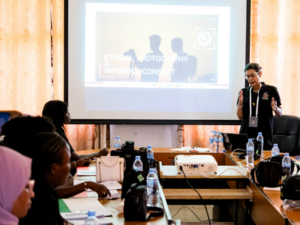
For months after, I reflected on that experience, which led me to learn more about ethical storytelling and to get certified during COVID. After the pandemic we resumed our work in Uganda. I added ethical storytelling to our curriculum and built the framework that guides everything I do as a photographer and how we work at Cameras For Girls.
Combining my ethical storytelling training with the work of Donald Miller of Storybrand, also helped me frame our work by asking whether we were acting as the hero or the guide.
The real question
To summarize, the first article, discussed whether our organizations have been the hero rather than the guide. In the second, I asked what has to change in practice if we truly want to become the guide.
This article questions whether, even after we make those changes, we are still holding too much power over the story itself? If the organization is still deciding what to shape, soften, edit, translate, shorten, approve, or leave out, then the shift from hero to guide is not complete.
Language may have changed. Tone may have improved. The team might be aligned on which story to share. But nevertheless, the power imbalance may still be there. If we are serious about ethical storytelling, this is the part we have to be most willing to examine—not just whether the organization has stepped out of the spotlight, but whether it has also loosened its grip on the story once it reaches its hands.
If your organization has begun changing the way it approaches storytelling or is trying to move more intentionally toward being the guide, I would love to hear what you are learning along the way. Please reach out to me at amina@camerasforgirls.org.
Amina Mohamed is the Executive Director at Cameras For Girls.