
What if the biggest reasons donors don’t engage are the ones we’re not paying attention to?
Fundraising teams today are being asked to do more than ever: reach more people, create more personalized experiences, drive more meaningful engagement. They’re rising to the challenge with incredible creativity and commitment.
But with resources stretched and expectations rising, the real question becomes: how do we make sure our effort translates into the greatest impact? This isn’t about working harder, it’s about being sharper. It’s about doing what matters most, in the moments that matter most, for the people who matter most.
That’s the real opportunity for development teams today – to deeply understand what drives giving intent and donor engagement and design strategies to maximize them. But to achieve this requires answering important questions that organizations across the sector are frequently grappling with:
- What do donors want and need to engage more deeply – do we really understand their motivations to give?
- What is the ideal donor experience – are we focusing on what matters most, where it matters most in the journey?
- Where are the greatest opportunities to drive efficiency and effectiveness across the donor journey?
Organizations face these questions at different stages of strategic maturity. Some, like a major university client at campaign midpoint had established donor journeys but needed greater clarity on where to focus limited resources. Others, like a major hospital foundation client crafting a targeted strategy for grateful patients, were designing experiences for high-value segments they had never systematically engaged. The framework works regardless of where organizations are focused. We also detail the university foundation’s experience from initial insights through implementation and early impact – to illustrate how the framework works in practice.
Why These Questions Matter More in Fundraising
These questions aren’t unique to fundraising. They emerge wherever organizations are trying to build relationships and influence behavior – in healthcare, financial services, retail, and more.
But for not-for-profits, the stakes are different. Because you’re not simply selling a product or offering a service; you’re inspiring belief, trust, giving, and action. And trust matters enormously: our research found that after personal financial changes, the top reason donors stop giving is because they no longer trust the organization they were giving to. It’s also important to not paint all donors with the same brush, as there are several differences in expectations and motivations that drive one to give, or stop giving, across the generations:
Gen Z: Early in their giving journey, Gen Z donors are driven by deeper relationships with the organization’s community and beneficiaries. Without making them feel welcomed, their giving behavior is less predictable.
Millennials: Building trust and meaningful connection is critical. Excessive or irrelevant communication can drive them away, as can feeling like ‘just a number.’
Gen X: This group is the only generation that cited a loss of connection as their primary reason for stopping donations
Boomers: Older donors value transparency and clarity on how their gifts are used. Like Millennials, excessive communication is a top driver for lapsing, highlighting the need for tailored and relevant engagement.
So, without answers to these questions, development teams are left with several knowledge and execution gaps that can prevent them from getting the most out of their strategy, their effort, and their investment.
The Five Knowledge and Execution Gaps
1. Emotions Get Ignored.
Most organizations focus on what donors get – the ‘rational’ stuff: access, updates, recognition – but miss that more than 50 percent of what actually drives behaviour is emotional: how donors want to feel when giving to a cause that matters to them. When teams aren’t asking the right questions to uncover these deeper motivations, they end up optimizing around incomplete insights.
2. Missing the Journey Map
Without mapping where these key drivers show up across the donor journey, teams lack clarity on which moments truly influence giving decisions versus those that don’t move the needle.
3. Data Without Direction
Organizations often measure what’s easy to track rather than what’s worth tracking. Resolving the first two gaps – that is, understanding what really motivates and when it truly matters – is key to unlocking richer data and insight on where to focus with greater intention.
4. Assuming One-Size-Fits-All
Segmenting by donation volume and frequency isn’t personalization – even within giving levels, donor motivations vary dramatically. Our research shows just how different these motivations can be: while over 80 percent of Boomer donors prioritize wanting to know how their gift is used, less than half of Gen Z donors care about that. Instead, Gen Z and Millennial donors place greater importance on relationship attributes – like interacting with beneficiaries and being part of a community – than their older peers.
5. Relying on History, Not Intent.
When teams focus on yesterday’s behavior rather than tomorrow’s intent, they miss both future opportunities and donations at risk. Traditional donor analysis relies heavily on historical patterns – giving frequency, gift progression, event attendance. But this tells you what donors have done, not what they’re planning to do. A donor questioning the organization’s direction won’t show up in historical metrics until they actually reduce their giving – by which point it’s often too late to address their concerns.
Informing A More Intentional Strategy: A Four-Step Approach
To resolve these gaps and bring more focus and intentionality into donor strategy, organizations need a different approach. The approach we developed, which we call GIVE, is purpose-built to inform strategies that unlock giving intent, value, and engagement.
First, Understand What Drives Giving (The ‘Why and What’ Donors Value)
The first step addresses several of these knowledge and execution gaps at once through its data-rich approach. Donors are exposed to over a hundred rational and emotional attributes, ensuring deliberate focus on the emotional aspects that are difficult for people to articulate and often ignored in research.
Data is also gathered on giving history and future intent, engagement preferences, and other segmentation details to provide many of the analyses and insights available in typical research, while going beyond in other areas, such as quantifying potential donations at risk by asking the question directly.
Source: Level5 Strategy
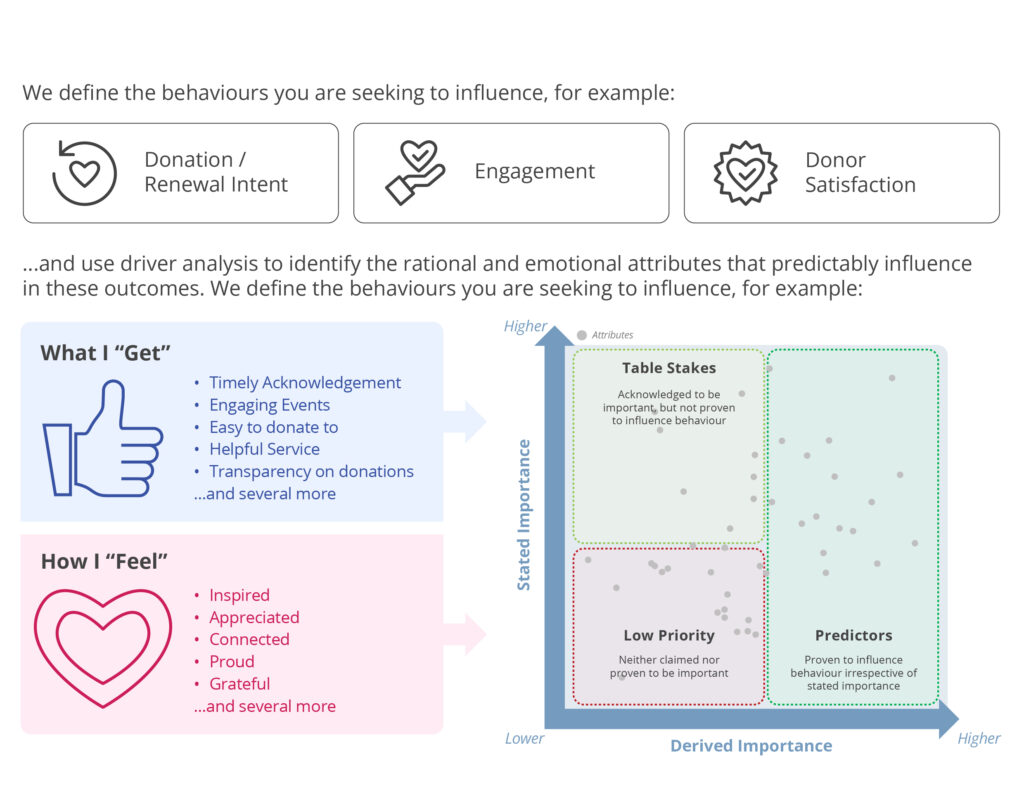
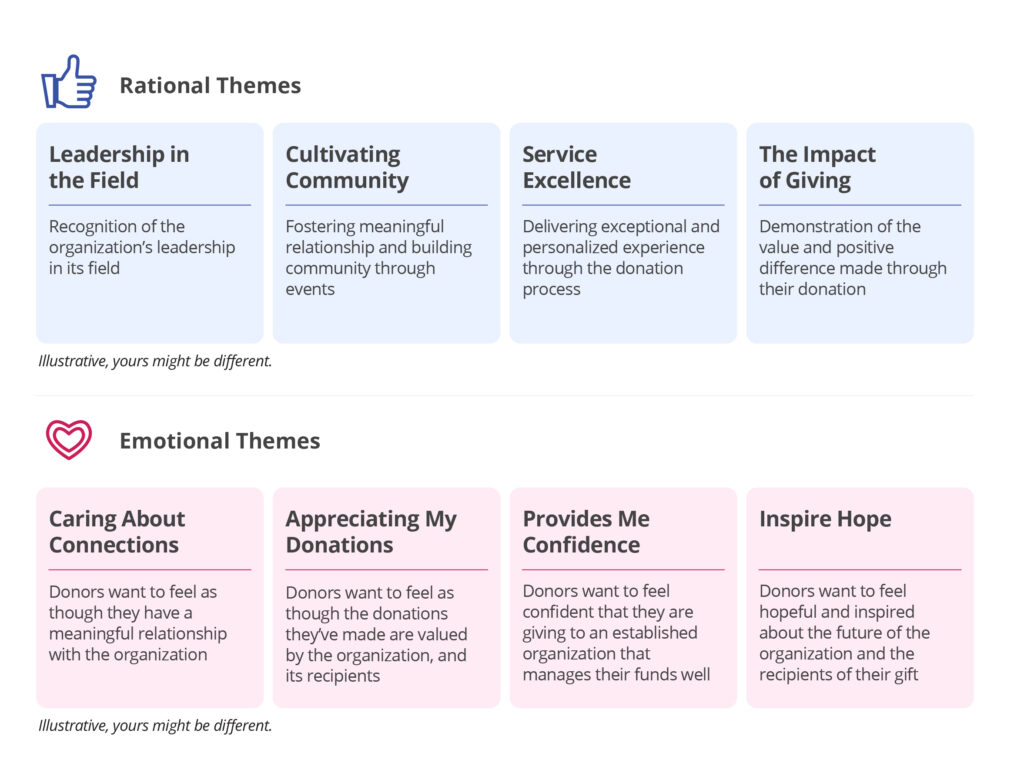
We define the behaviours you’re seeking to influence – donation and renewal intent, engagement, and donor satisfaction – and use driver analysis to identify the rational and emotional attributes that predictably influence those outcomes. We look at both what donors ‘get’ and how they ‘feel,’ comparing what donors say matters (stated importance) with what actually drives behaviour (derived importance).” The most important attributes tend to organize into clear, actionable themes that offer a more focused picture of what really matters and provides a shared language across your team.
Source: Level5 Strategy
In essence, this approach helps shift these insights from being abstract ideas to clear themes everyone can rally around. For example, attributes connected to fostering meaningful relationships or attending events fall into Cultivating Community. On the emotional side, donors want to feel as though their donation was appreciated – emotional attributes that align to this, such as recognized, fulfilled, or valued, fall into that theme.
Second, Assess Performance Against the Ideal (The ‘How Are We Doing’)
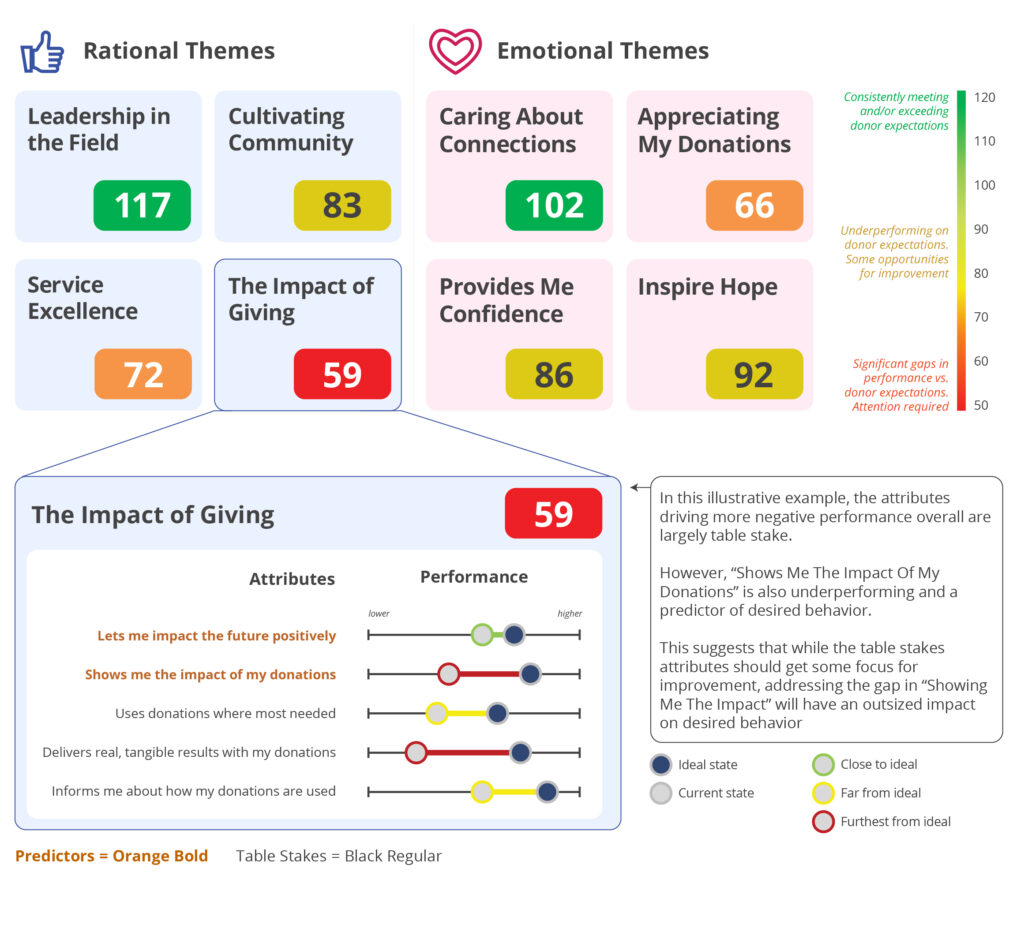
It is also critical to ask about both a donor’s experience with your organization and their ideal experience with any not-for-profit (not to mention other ‘comparator’ organizations if that level of insight is also of interest). This dual lens is critical to assess performance: are you doing well on what matters most?
What’s particularly powerful are the insights this provides at a granular attribute-by-attribute level – allowing deeper dives into root causes. But it also provides the data to elevate the conversation for executive decision making and provide a basis for ongoing score-carding.
Ultimately, this helps to focus attention on where improvements to the donor experience, are best placed to drive results and desired impact. If something is underperforming but low impact, don’t overreact. But if you’re falling short on a key predictor of giving behaviour – that should become a higher priority.
Source: Level5 Strategy
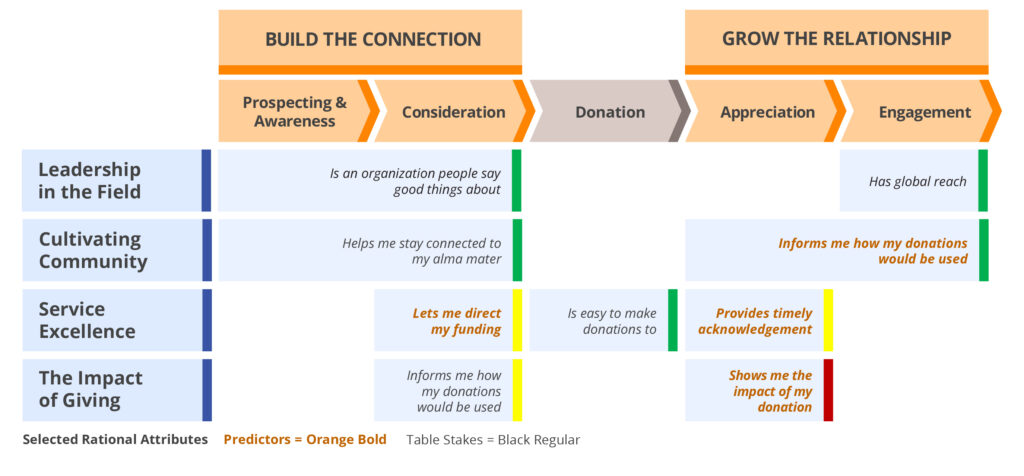
Next, Map to the Donor Journey (The ‘Where It Matters’)
With clear themes identified and performance assessed, mapping these insights to your donor journey to see where the drivers and performance needing attention are playing out helps focus action and clarifies which parts of the organization need to be involved in ideating solutions.
The insights that connect to the earlier stages of the journey are especially interesting, not just for what you might do for current donors, but for shaping strategies for engaged prospects who haven’t yet given.
Source: Level5 Strategy
Finally, Prioritize Targeted Action (The ‘What to Do With It’)
Now, with this level of clarity – on what matters, how you’re performing, and where in the journey it matters most – you can get very focused on where to act. Don’t try to overhaul everything. Instead, prioritize areas with the biggest performance gaps AND potential to influence giving intent and donor engagement. For example, if a key predictor of behaviour such as ‘Shows me the impact of my donation’ is also underperforming, you may need initiatives focused on your impact reporting process.
In some cases, that means reinforcing strengths. In others, it means making deliberate changes in focus away from certain activities and improving things that matter most. And the most important mindset shift is this: it’s not about doing more, it’s about doing much better in fewer places.
This ability to focus resources on what truly drives desired outcomes is key to ensuring a strategy sticks; in fact, our research shows that nearly 4 in 5 executives say that one reason their strategy failed is due to lack of clear prioritization.
Case Study: A Major University Foundation’s Experience
One of North America’s largest universities, at the midpoint of a multi-billion dollar campaign, faced a strategic challenge. Despite strong momentum across their decentralized fundraising community, leadership had a clear mandate – deliver a best-in-class donor experience while driving operational efficiency – but lacked a shared understanding of what “best-in-class” actually meant.
The development team had nearly 30 fundraising units operating somewhat independently across faculties and divisions. Beyond anecdotal feedback, they didn’t know how donors felt about their experience or where the real gaps were in their stewardship journey. Like many organizations, they could see historical giving patterns but couldn’t identify which donors were questioning their continued support or which were ready for deeper engagement.
What the Research Revealed
The research surfaced several insights that shifted their strategic thinking. Over $30 million in donation value was at risk, with a third of donors undecided about future giving and 13 percent not intending to renew.
While surprising, it signaled an opportunity to understand which levers could shift these donors toward renewal.
Their recognition society (for donors giving ~$1,500 USD+ annually) proved far more important than expected, speaking to donors’ need for connection to the broader university beyond just their specific faculties. This was particularly striking given industry-wide conversations about the value of recognition societies.
The communication of impact gap was difficult to hear but critical to address. Annual impact reporting was table stakes, but they needed to weave tangible impact into all donor touchpoints, not just annual reports.
The insights connecting to earlier journey stages proved particularly valuable. Since 75 percent of donors were also alumni, they could use findings about what motivates current donors to shape strategies for engaged alumni who hadn’t yet made their first gift.
Making the Hard Choices
Equipped with these insights, the organization made several deliberate choices about where to focus and what to change. The hardest part wasn’t identifying opportunities; it was maintaining discipline to focus on a manageable number of high-impact initiatives. Getting alignment meant prioritizing internal operations first. Their first-year action plan weighted heavily toward enhancing internal processes, which meant pausing initiatives like digital reporting tools.
Some longstanding stewardship activities were reduced or eliminated to create capacity for higher-impact work. The discipline to say no to good ideas, and focus on doing better in fewer places, proved essential.
Getting Buy-In Across the Organization
Two things proved critical for getting the organization aligned and willing to act on the insights.
First, they linked the work directly to their advancement strategic plan. They weren’t creating new priorities; they were supporting identified strategic areas of focus. When executives saw specific performance gaps quantified against donor-defined ideal experiences, resource allocation discussions became less political and more evidence-based.
Second, they created internal champions by establishing a donor experience working group with 20 people from stewardship, donor services, communications, and frontline fundraising across the university community. The group initially acted as an internal focus group, building understanding of shared pain points. Once they had GIVE insights, the group helped shape their donor experience vision and develop their action plan.
This collaboration and co-creation took time, but proved essential for driving clarity, alignment, and meaningful change across their decentralized structure.
Early Signs of Progress
Within the first year, several positive signals emerged. Teams showed strong engagement in adopting the new framework pillars in their annual planning: cultivate connection and community, demonstrate tangible impact, meaningful acknowledgement, and commitment to service excellence.
Many initiatives are bigger system changes that take time, especially in their environment where stewardship responsibility is distributed across nearly 30 teams. While the central team focuses on longer term initiatives, faculty teams have begun implementing quick wins in their local programs.
For example, teams have consolidated donor and alumni events to build connection across audiences while freeing resources for enhanced impact communications. Their Faculty of Dentistry implemented “Thank You Thursday” and a simple email strategy to complement annual impact reporting with real-time updates – authentic, in-the-moment content that’s easy to curate. They’ve received positive donor feedback on both initiatives.
By taking a systematic approach to answering the fundamental questions they faced – what truly motivates donors, where performance gaps exist, and which moments in the journey matter most – the organization moved from operating on assumptions to acting with strategic clarity. The discipline to focus on fewer, higher-impact initiatives and the framework for ongoing measurement set them on a more intentional path that continues to guide their campaign strategy as donor expectations evolve.
What Does It Take to Build a More Intentional Donor Strategy?
Organizations that successfully implement this approach see measurable improvements in donor satisfaction, retention rates, and giving growth. They also report better internal alignment, more efficient resource allocation, and greater confidence in strategic decision-making. But these outcomes don’t happen automatically – they require commitment to several fundamental principles:
1. Understand What Drives Giving & Engagement. You need to understand what truly drives giving and sustained engagement – not just what donors get, but how they feel, and recognize that motivations may vary even within your donor segments. This Unlocks…Enhanced leadership alignment as executive decisions become easier to make and defend because they’re grounded in concrete donor insights rather than competing opinions.
2. Get Visibility Into How Well You’re Delivering. Assess performance through the donors’ eyes, not just your own metrics. This requires systematic measurement against both your current performance and donors’ ideal experiences. This Unlocks…Strategic confidence as teams move from “we think this might work” to “we know this drives giving.” Staff report greater certainty because decisions are anchored in evidence.
3. Focus Where and When It Matters Most. Not every moment in the donor journey carries the same weight. Map your insights to understand where impact truly happens and concentrate efforts accordingly. This Unlocks… Sustainable focus as organizations develop discipline to concentrate on high-impact activities rather than spreading efforts thin. The ‘better in fewer places’ mentality becomes embedded in how teams evaluate opportunities.
4. Make Data Actionable For Leaders. Transform your analysis into clear insights that actually drive executive discussion and decisions. Without leadership alignment, even the best insights won’t translate to action. This Unlocks…Cross-departmental collaboration as development, marketing, and program teams coordinate naturally around shared understanding of donor motivations. Silos break down when everyone understands what actually drives behavior.
5. Act With Clarity and Focus. Resist the temptation to address every opportunity. Focus on areas with the biggest performance gaps and potential to influence giving intent and donor engagement. This Unlocks…Resource efficiency as capacity is freed up from lower-value initiatives, creating bandwidth for additional strategic work rather than just maintaining existing programs.
6. Continue to Listen, Measure and Adapt. Your strategy must stay aligned with what truly matters to donors. This requires ongoing measurement and willingness to adapt as you learn. This Unlocks…Ongoing strategic intelligence as performance tracking becomes systematic rather than episodic. Strategy refinement happens continuously based on evidence rather than reactive responses to isolated feedback.
The Opportunity Ahead
In an environment where donor expectations continue to rise and resources remain constrained, the organizations that will thrive are those that can focus their efforts on what truly drives giving intent, value, and engagement.
This isn’t about having perfect data or implementing complex systems. It’s about bringing intentionality to your strategy – understanding what matters most to your donors, assessing how well you’re delivering against those priorities, and focusing your efforts where they can have the greatest impact.
The opportunity to transform insights into impact is available to every organization willing to ask harder questions, make difficult choices, and commit to doing better in fewer places. The question isn’t whether your donors have clear expectations and motivations – they do. The question is whether you’ll invest in understanding them deeply enough to align your strategy accordingly.
The university foundation’s experience demonstrates what’s possible when organizations commit to systematic understanding of donor motivations. But their success came not from the insights alone; it came from the discipline to act on what they learned – focusing resources on what truly drives donor engagement rather than what feels intuitively important.
For organizations ready to make this commitment, the framework provides a proven path forward. Success requires moving beyond good intentions to systematic action, and that starts with asking the right questions about what really drives your donors’ decisions.
Jordan Shapiro is Managing Partner of Level5 Strategy. He can be reached at jshapiro@level5strategy.com. Laura Richard is Principal, Level5 Straetgy. She can be reached at lrichard@level5strategy.com. Level5 Strategy is a leading boutique consulting firm that helps organizations build ‘strategies that stick’. Our private-, public-, and not-for-profit sector clients turn to us when they’re looking to expand their reach, enhance their execution, and evolve their organization. They come for the ‘right’ strategy, and the assurance that in working with us they are building the enduring commitment needed to deliver it.